
The Ultimate Field Guide to Peruvian Birds: A Journey Through the Amazon and Andes

South America is widely celebrated as the planet’s “Bird Continent,” a landmass teeming with avian biodiversity that captures the imagination of naturalists worldwide. However, within this vast continent, one nation stands out as the crown jewel of ornithology: Peru. For serious birders, evolutionary biologists, and casual nature lovers alike, the sheer density and variety of Peruvian birds transform a simple vacation into a life-changing expedition.
With a national checklist that exceeds 1,800 confirmed species, Peru holds the distinction of being home to nearly 20% of the world’s total bird population. This is not merely a statistic; it is a testament to the country’s extraordinary geographical complexity. From the arid, wind-swept coasts of the Pacific to the jagged, ice-capped peaks of the Andes, and down into the sweltering, humid depths of the Amazon Rainforest, every elevation and microclimate offers a unique niche. This guide invites you to explore the fascinating lives, habitats, and behaviors of the creatures that rule these skies.
The Ecological Canvas: Understanding the Diversity
To comprehend why Peruvian birds are so incredibly diverse, one must first look at the map. Peru is a land of dramatic contrasts. It is a vertical country where you can travel from sea level to 6,000 meters and back down to 200 meters in a matter of days.
The primary architect of this biodiversity is the Andes Mountain Range. Acting as a massive geological spine, the Andes divide the country, creating isolated valleys where species have evolved independently over millions of years. To the west, the frigid Humboldt Current sweeps up from Antarctica, cooling the coast and creating a desert ecosystem that, while dry, is surprisingly rich in seabirds. To the east, the mountains act as a barrier to the trade winds, trapping moisture and creating the lush cloud forests that eventually bleed into the vast Amazon Basin.
This collision of geography and climate creates a “speciation engine.” It ensures that a trip to Peru is never just about one ecosystem. It is a journey through a kaleidoscope of habitats, each populated by a distinct community of Peruvian birds adapted to specific, often extreme, conditions.
1. The Andean Cock-of-the-rock: Flame of the Cloud Forest
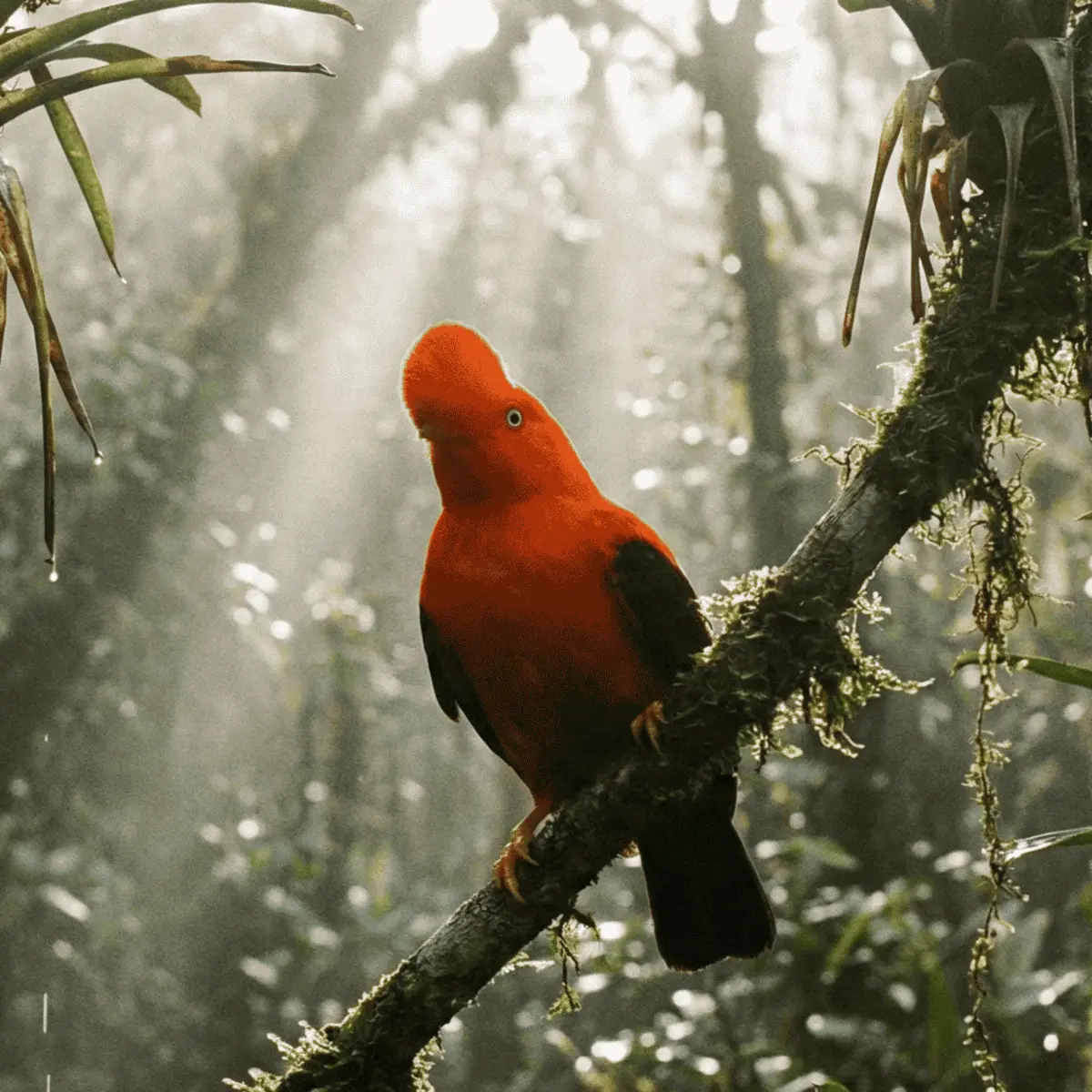
Deep within the montane cloud forests, situated between 500 and 2,400 meters above sea level, resides a creature that looks less like a bird and more like a mythical beast. The Andean Cock-of-the-rock (Rupicola peruvianus) serves as the National Bird of Peru, a title it earns through sheer charisma and visual splendor.
The Dance of the Lek
While the females are a cryptic, rusty brown color—perfect for blending into nesting caves—the males are a vibrant, neon orange. Their most striking feature is a disk-like crest of feathers that permanently covers their beak, giving them a unique silhouette among Peruvian birds.
However, it is their behavior, not just their looks, that draws travelers to the cloud forest. Males gather in communal display arenas known as “leks.” Here, the forest floor becomes a stage. Several males will congregate to perform an elaborate dance, hopping between branches, bowing, snapping their wings, and emitting low, guttural croaks. When a female descends to inspect the suitors, the activity reaches a fever pitch. This display is a raw, energetic competition for genetic dominance, offering human observers a front-row seat to the mechanisms of sexual selection.
Where to Find Them
The Cock-of-the-rock is most easily spotted in the Manu Biosphere Reserve (along the Manu Road) or near Tarapoto in northern Peru. Protecting these birds means protecting the cloud forest, a critical watershed that acts as a buffer between the highlands and the Amazon.
2. The Andean Condor: Lord of the Canyon

While the Cock-of-the-rock rules the dense understory, the high-altitude skies belong to the Andean Condor (Vultur gryphus). Weighing up to 15 kilograms and boasting a wingspan of over 10 feet, the Condor is one of the largest flying birds on Earth. In the folklore of the Andes, the Condor was revered by the Inca civilization as a sacred messenger to the gods, a bridge between the earth and the heavens.
Mastery of Aerodynamics
Unlike smaller Peruvian birds that must flap constantly to stay aloft, the Condor is a glider. It relies on thermal updrafts—columns of warm air rising from deep canyons—to gain altitude. A Condor can travel hundreds of miles in a single day with hardly a flap of its wings, scanning the landscape for carrion.
Watching a Condor rise from the depths of the Colca Canyon or the Cotahuasi Canyon is a lesson in physics. As the morning sun warms the canyon walls, the birds release their grip on the cliffside roosts and step into the void, catching the air currents with effortless grace.
Conservation Concerns
Despite their majesty, Condors are vulnerable. They are slow to reproduce, raising only one chick every two years. They also face threats from poisoning and habitat encroachment. Conservation programs are currently working to tag and monitor these massive Peruvian birds to ensure they continue to patrol the Andean peaks for generations to come.
3. The Marvelous Spatuletail: A Hummingbird Like No Other
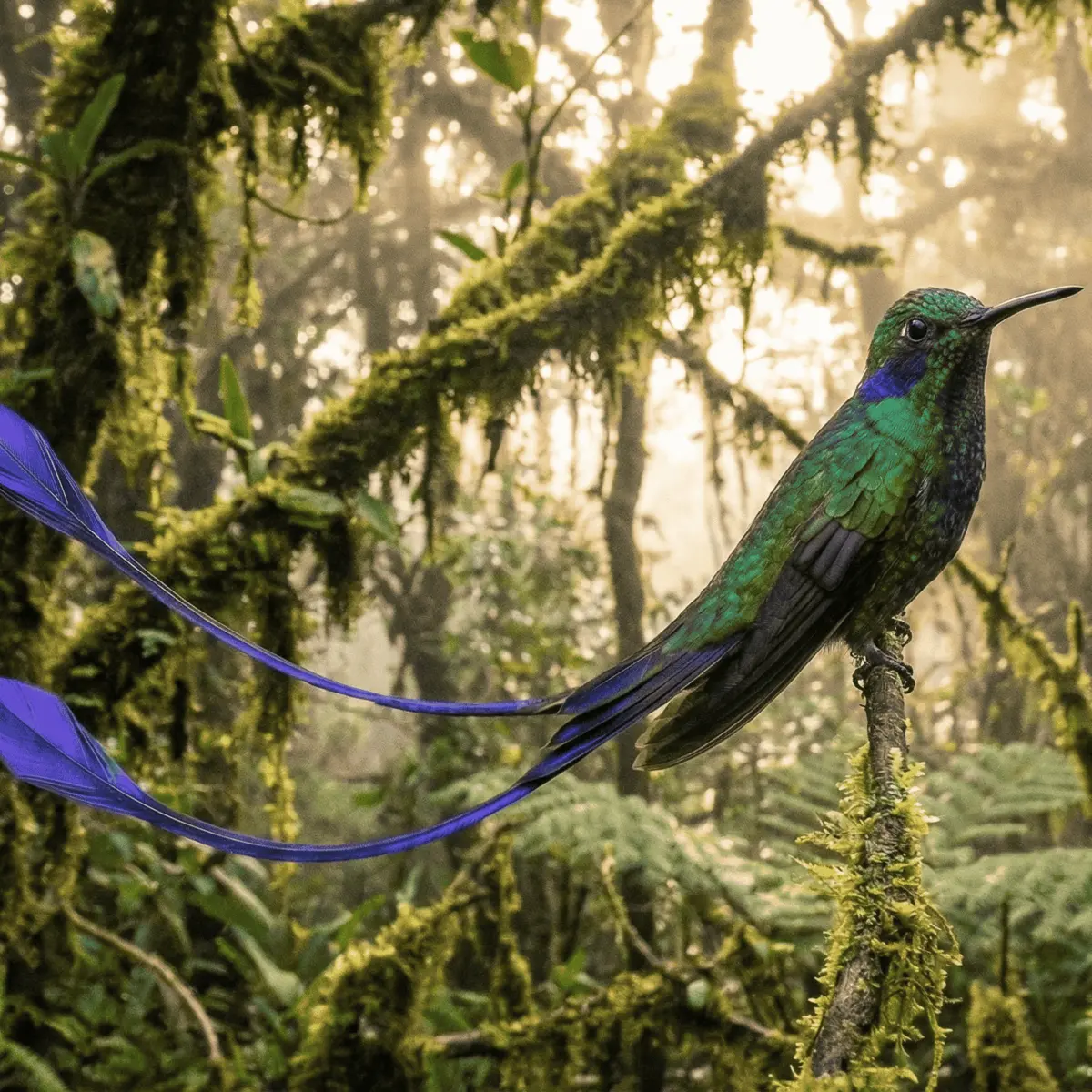
If the Condor represents size and power, the Marvelous Spatuletail (Loddigesia mirabilis) represents delicacy and evolutionary extravagance. Found only in a tiny, fragmented area of the Rio Utcubamba valley in northern Peru, this hummingbird is an endemic treasure. It exists nowhere else on the planet, making it a “Holy Grail” sighting for ornithologists.
The Physics of Attraction
The male Spatuletail possesses one of the most unusual tail structures in the avian world. He has just four tail feathers. The outer two are elongated, wire-like filaments that end in large, violet-blue discs, or “spatules.” These feathers can be moved independently. During courtship, the male hovers in front of a female and whips these heavy spatules around his body in a frantic, clicking dance.
Considering the immense energy required for hummingbirds to hover, adding the weight and drag of these tail feathers seems counter-intuitive. Yet, this is a prime example of the runaway selection often seen in Peruvian birds, where the need to attract a mate overrides the need for energy efficiency.
protecting a Micro-Habitat
Because its range is so small, the Spatuletail is listed as Endangered. Local communities, recognizing the value of avitourism, have begun planting the specific red-flowering Alabaster bushes the birds rely on. Visiting the Huembo Reserve helps fund these community-led conservation efforts.
4. Macaws: The Technicolor Giants

Descending the eastern slopes of the Andes, the cool air fades, replaced by the heavy, humid blanket of the Amazon Rainforest. Here, the canopy erupts in color. The Red-and-Green Macaw and the Scarlet Macaw are the loudest and most ostentatious of the Peruvian birds inhabiting the lowlands.
The Mystery of the Clay Licks
While Macaws are beautiful in flight, the true spectacle occurs at the collpas, or clay licks. In regions like Tambopata and Manu, massive cliffs of exposed river clay attract hundreds of parrots and macaws every morning.
Scientists have debated why these birds engage in geophagy (eating dirt). The prevailing theory is twofold: the clay provides essential sodium lacking in their diet, and it may help neutralize toxins found in the unripe seeds and fruits they consume. Watching a “macaw wave” descend upon a clay lick is a sensory overload; the air fills with the screeching calls of hundreds of Peruvian birds and a kaleidoscope of red, blue, green, and yellow feathers.
Icons of the Amazon
Macaws are highly intelligent, social creatures that mate for life. Their strong beaks are capable of cracking the hardest Brazil nuts. Unfortunately, their beauty makes them targets for the illegal pet trade. Ecotourism plays a vital role here; when locals can earn a living guiding tourists to see wild Macaws, they are less likely to participate in trapping or logging.
5. The Andean Flamingo: Pink Jewels of the Altiplano

When we think of flamingos, we often picture tropical Caribbean lagoons. However, three species of flamingos make their home in the high Andes, with the Andean Flamingo (Phoenicoparrus andinus) being the rarest. These Peruvian birds thrive in the Altiplano, a high-altitude plateau sitting at over 3,000 meters above sea level.
Surviving the Salt
The lakes of the Altiplano are often hypersaline and caustic, environments that would be toxic to most life. The Andean Flamingo, however, has evolved to filter-feed on the microscopic algae and diatoms that bloom in these waters. Their distinct yellow legs and black-tipped wings set them apart from other species.
Historically, the flamingo is deeply woven into Peru’s identity. Legend has it that the red and white colors of the Peruvian flag were inspired by a flock of flamingos taking flight, witnessed by the liberator José de San Martín. Thus, these Peruvian birds are not just biological entities; they are national symbols.
A Fragile Existence
Climate change poses a severe threat to the wetlands (bofedales) where these flamingos feed. As glaciers recede and rain patterns shift, the delicate water balance of the high Andes is disrupted. protecting these high-altitude wetlands is crucial for the survival of the flamingo and the indigenous communities that rely on these water sources.
6. The Torrent Duck: Mastering the Whitewater

Leaving the stagnant salt lakes, we move to the rushing rivers that carve through the Andean slopes. Here lives the Torrent Duck (Merganetta armata), a species that has conquered one of the most physically demanding environments imaginable.
Hydrodynamic Design
The Torrent Duck is a specialized swimmer adapted to life in fast-flowing, rocky rivers. With a streamlined body, powerful webbed feet, and a stiff tail used as a rudder, they navigate Class IV and V rapids with ease. It is a surreal sight to watch these Peruvian birds swimming upstream against a current that would drown a human, casually diving into the foam to snatch stonefly larvae from submerged rocks.
The Bio-Indicator
Torrent Ducks are strictly territorial and monogamous. Importantly, they are bio-indicators of river health. They require crystal-clear, highly oxygenated water to hunt. If a river becomes polluted by mining runoff or heavy sedimentation from deforestation, the Torrent Ducks disappear. Therefore, spotting one of these Peruvian birds in the Sacred Valley or near Machu Picchu is a sign of a healthy ecosystem.
7. The Burrowing Owl: The Desert Sentinel
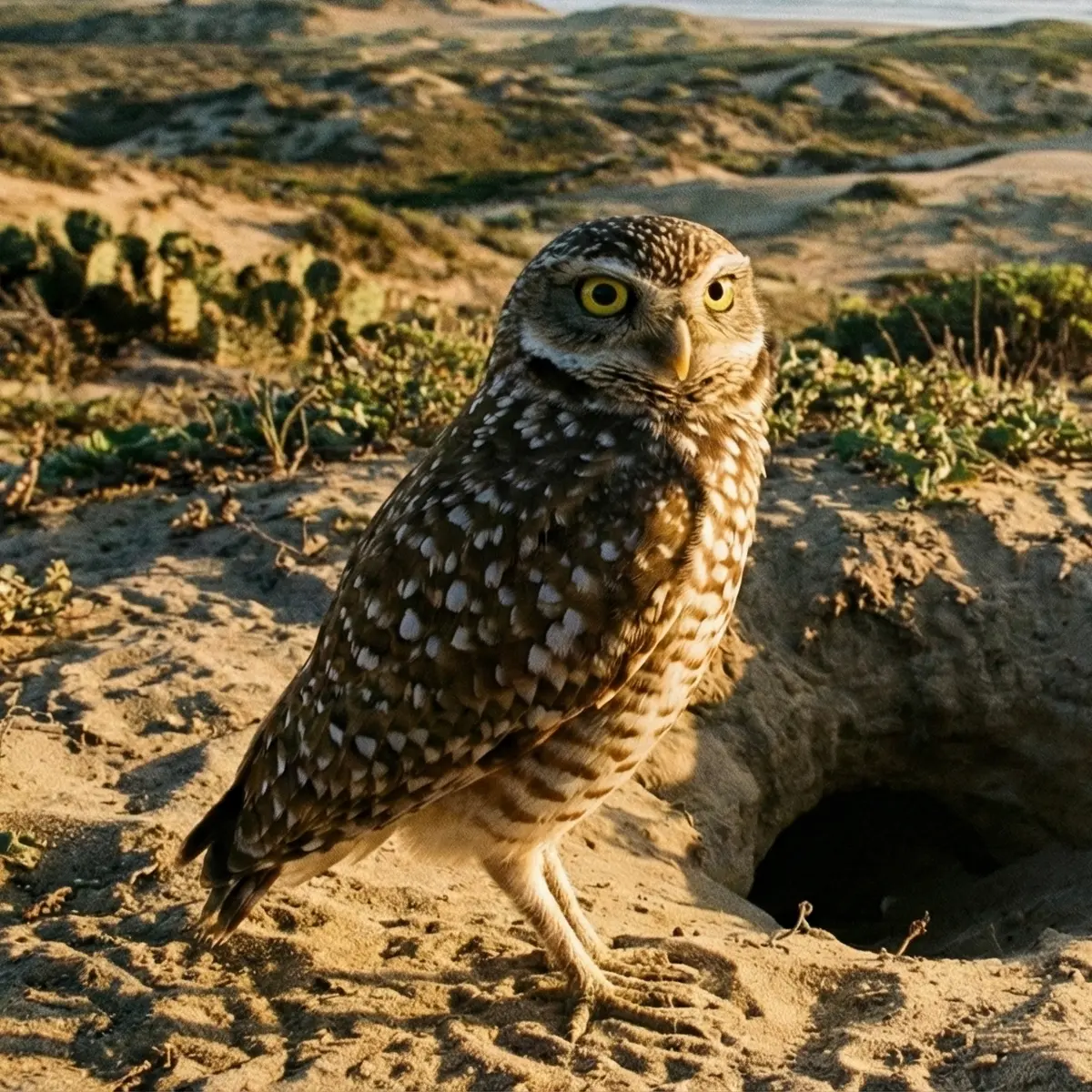
Finally, we return to the arid coast to meet a bird that has learned to live alongside humans: the Burrowing Owl (Athene cunicularia), known locally as the Huerequeque. Unlike the reclusive forest owls, these are active during the day and are among the most charismatic of all Peruvian birds.
Architects of the Sand
As their name implies, these owls live underground. In the soft sands of the coastal desert, they dig their own burrows or takeover holes left by mammals. They are often seen standing guard on mounds of dirt, bobbing their heads comically when approached.
They have adapted remarkably well to the encroachment of cities. It is not uncommon to find Burrowing Owls living in archaeological sites, golf courses, or university campuses in Lima. They serve as natural pest control, hunting beetles, rodents, and small lizards. Their ability to thrive in semi-urban environments highlights the resilience of Peruvian birds in the face of a changing world.
Birding Routes: How to Plan Your Trip
Given the size of the country, birders usually divide Peru into three main circuits. Understanding these routes is key to maximizing your checklist of Peruvian birds.
The Northern Route
This route is famous for its high rate of endemism. It crosses the Andes at a lower elevation than in the south, creating unique habitats. Key targets here include the Marvelous Spatuletail and the Long-whiskered Owlet. This route takes you through the Marañón Valley, often called the “Grand Canyon of South America,” which serves as a barrier creating unique species on either side.
The Central Route
Starting in Lima, this route climbs the steep central highway into the high Andes. It is intense and reaches dizzying altitudes quickly. It is the best route for seeing high-altitude specialists like the Diademed Sandpiper-Plover. The diversity drops as you go higher, but the rarity of the Peruvian birds found here increases.
The Southern Route
This is the most popular tourist route, encompassing Cusco, Machu Picchu, and the Manu Road. It offers the classic cross-section of habitats: from the high Andes down to the Amazon lowlands. This route offers the highest quantity of species, including the Cock-of-the-rock, Macaws, and Tanager flocks. For a first-time visitor wanting to see a high volume of Peruvian birds, the Southern Route is the best choice.
The Economic Power of Avitourism
The conservation of these species is no longer just a biological imperative; it is an economic one. Birdwatching tourism, or avitourism, has become a significant source of revenue for Peru.
When a traveler spends thousands of dollars to visit a lodge in the rainforest, that money supports local staff, buys local produce, and funds the maintenance of the reserve. This creates a value chain where a living tree housing a Harpy Eagle nest is worth exponentially more than the timber it would provide if cut down.
Communities that previously relied on slash-and-burn agriculture are transitioning to eco-tourism. They are training as specialized guides who can identify Peruvian birds by a single chirrup or a flash of color. This shift is crucial for sustainable development. It empowers local populations to become the stewards of their own land, ensuring that the biodiversity of the Amazon and Andes remains intact for future generations.
Practical Tips for the Aspiring Birder
If this guide has inspired you to pack your bags, here are some practical tips to ensure you get the most out of your search for Peruvian birds.
1. Timing Your Visit
While Peru is a year-round destination, the transition months (May and September) often offer the best balance of weather. The Amazon is best visited during the dry season (May to October) to avoid muddy trails. However, bird activity is often high at the start of the rainy season when fruits are blooming.
2. Essential Gear
You do not need a camera with a massive lens to enjoy the wildlife, but a good pair of binoculars is non-negotiable. 8×42 or 10×42 magnification is ideal for the dim light of the rainforest. A field guide is also essential. Birds of Peru by Schulenberg is the definitive text, though it is heavy. Many birders now use mobile apps that contain audio recordings of calls, which are vital for identifying Peruvian birds in dense foliage.
3. The Value of a Guide
Do not attempt to bird the Amazon or the deep Andes alone. The environments are vast and can be dangerous for the unprepared. More importantly, professional local guides are incredibly skilled. They possess “laser eyes” and can spot a green parrot against green leaves instantly. Hiring a guide also ensures that your tourism dollars go directly to the people who know and protect these Peruvian birds.
4. Ethical Observation
With the rise of digital photography, ethical birding is more important than ever. Avoid using “playback” (playing recorded bird songs) excessively, as this stresses the birds and distracts them from feeding or mating. Never get too close to a nest. The welfare of the animal must always come before the perfect Instagram shot. We are visitors in their home; we must tread lightly.
Conclusion: A World of Winged Wonders
Peru is more than just Machu Picchu and ceviche. It is a living, breathing museum of natural history. From the bone-dry deserts of the coast to the steaming jungles of the east, the country offers a masterclass in adaptation and survival.
The Peruvian birds we have explored—the flamboyant Cock-of-the-rock, the soaring Condor, the rare Spatuletail, and the resilient Burrowing Owl—are just a tiny fraction of the life that fills this land. Each species tells a story of the landscape it inhabits. To watch them is to witness the pulse of the ecosystem.Whether you are a “lister” obsessively checking off species, or a traveler who simply finds joy in the flash of a wing, Peru welcomes you. The skies here are alive. So, bring your binoculars, bring your curiosity, and look up. The Peruvian birds are waiting to show you the world from a different perspective.
BLOG HOME: